
Every January, we see the same pattern: people rush to file their Self Assessment return in the final days… and then get caught out by the second half of the equation, having the cash available to pay the bill on time.
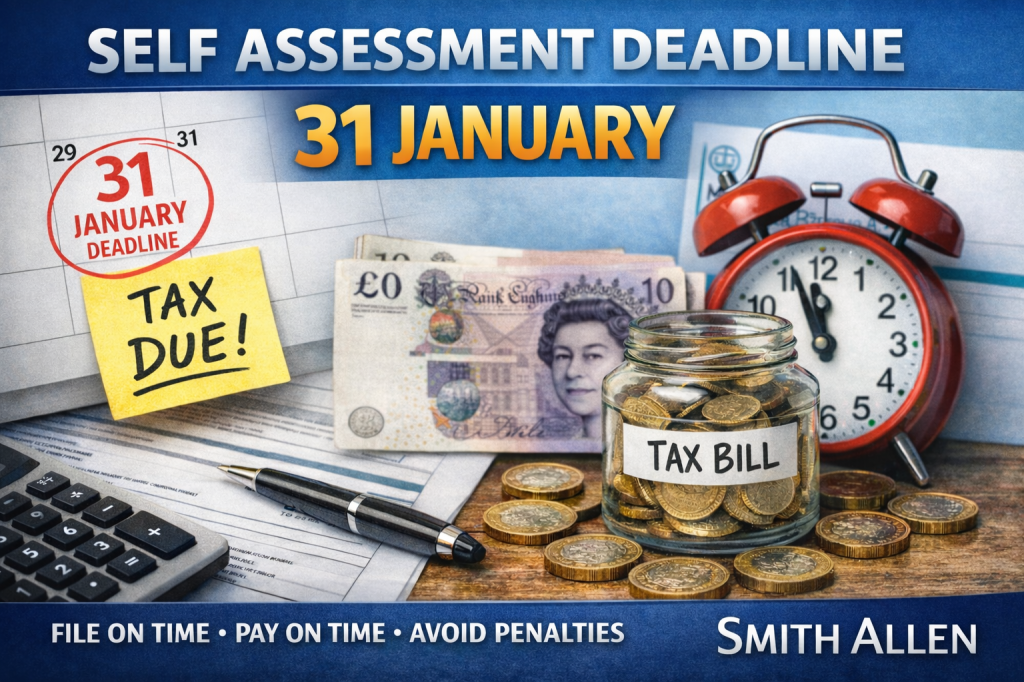
For the 2024/25 tax year (6 April 2024 to 5 April 2025), the key online deadline is 11:59pm on 31 January 2026 for both filing and paying.
This article explains the deadlines, what penalties can apply, and importantly who is responsible for what when an accountant is involved.
The key dates you need in your diary
For most individuals:
- Paper return deadline: 11:59pm on 31 October 2025
- Online return deadline: 11:59pm on 31 January 2026
- Payment deadline: 11:59pm on 31 January 2026
- If you pay by “Payments on Account” (many self-employed people and landlords do): there’s also a second payment date of 31 July
- If you want HMRC to collect what you owe through your PAYE tax code (where eligible), you must file by 11:59pm on 30 December 2025
The “gotcha”: filing is one deadline, paying is another problem
A lot of people think: “If I file the return by 31 January, I’m safe.”
Not quite.
HMRC treats late filing and late payment separately. You can file on time and still face charges if the payment is late.
And what you owe by 31 January often includes more than you expect, because it can be made up of:
- Balancing payment for the tax year just ended, plus
- First Payment on Account towards the next tax year (where applicable).
HMRC explains that payments on account are normally two instalments (31 January and 31 July), each typically half of last year’s tax liability (with some exceptions).
That’s why January bills can feel steep: you may be paying last year’s remainder and an advance payment for the next year at the same time.
What penalties apply if you miss the deadlines?
Late filing penalties (even if you owe no tax)
HMRC’s Self Assessment late filing penalties are:
- £100 immediately after the deadline
- After 3 months: £10 per day, up to £900
- After 6 months: the higher of £300 or 5% of the tax due
- After 12 months: another £300 or 5% (whichever is higher)
Yes, the £100 can apply even if there’s no tax to pay.
Late payment penalties and interest
If you pay late, HMRC can charge:
- 5% of tax unpaid at 30 days, 6 months, and 12 months, plus
- interest on the amount owed.
As at 9 January 2026, HMRC’s published late payment interest rate is 7.75% (rates can change, as they’re linked to the Bank of England base rate).
“My accountant will sort it” but whose responsibility is it, legally?
Using an accountant is often the right move, but it doesn’t transfer legal responsibility away from you.
HMRC’s own tax return notes are explicit: even if someone else fills in your return, you’re still responsible for the information on it.
Professional standards mirror this. ICAEW’s PCRT guidance states the taxpayer has primary responsibility to submit correct and complete filings, while the adviser is responsible to the client for accuracy based on information provided.
In plain English:
- You are responsible for providing complete, accurate information and reviewing/approving the return.
- Your accountant is responsible for preparing the return competently from what you provide, asking sensible questions, and filing it once approved.
So if records arrive on 29 January, the real risk isn’t just “late filing” it’s rushed work, missing information, and avoidable errors.
Why leaving it late causes problems (even with a good accountant)
Most firms are working flat-out in January. The practical reality is:
- We may not have time to chase missing items, resolve queries, or correct inconsistencies.
- HMRC login/access issues and third-party delays (banks, platforms, pension providers, crypto exchanges) can hold things up.
- If you’re due to make payments on account, the bill can be bigger than expected, and finding cash at the last minute is rarely comfortable.
Even HMRC encourages budgeting by allowing you to estimate your bill and plan ahead.
How to make sure you have the money ready to pay
Here are three sensible approaches we often recommend:
1) Estimate early, then save steadily
If you file earlier, you get certainty earlier and more time to plan. (LITRG notes this is especially helpful if you’re moving onto payments on account for the first time.)
2) Use HMRC’s Budget Payment Plan (optional)
HMRC lets you set up a Budget Payment Plan to pay weekly or monthly by Direct Debit towards your next Self Assessment bill (you must be up to date with previous payments).
3) If you can’t pay on time, act early, Time to Pay
If you’re struggling, you may be able to set up a payment plan (Time to Pay) in instalments. HMRC explains what you’ll need and how to apply.
If your income has dropped, check whether Payments on Account can be reduced
If you know the next year’s tax will be lower than last year, you may be able to reduce payments on account (but be careful, reducing too far can lead to interest on the shortfall).
This is an area where tailored advice matters, because the “right” answer depends on your current-year profit and other income.
What we need from you to file accurately (and on time)
HMRC’s guidance lists the kind of documents most people need, such as P60/P11D/P45, business records, bank statements, dividend information and pension contribution details.
In practice, we usually ask clients to provide (as applicable):
- Employment info (P60/P11D, benefits, expenses)
- Self-employed accounts/records and allowable expenses
- Rental income and property expenses
- Bank interest and dividend statements
- Pension contributions and Gift Aid
- Capital gains transactions (shares/crypto/property disposals)
- Student loan position (where relevant)
The earlier we have this, the more time we have to get it right.
Can you appeal penalties if something goes wrong?
Sometimes, yes, but HMRC usually requires a “reasonable excuse” and expects you to act as soon as you’re able.
HMRC’s examples of what may count include bereavement, serious illness, IT failure, issues with HMRC online services, fire/flood/theft, and in some circumstances relying on someone else who didn’t send the return.
But “I didn’t have enough money” is specifically listed as something that will not usually count as a reasonable excuse.
A sensible plan for the next two weeks
If you’re reading this in January:
- Gather your documents today (don’t wait for the weekend).
- Confirm whether payments on account apply (and whether your January bill includes them).
- If cash is tight, explore Budget Payment Plan or Time to Pay early , don’t leave it until after the deadline.
- If you want the option of paying via PAYE coding (where eligible), remember the 30 December filing cut-off for that route.
Need help getting your Self Assessment filed (and paid) with confidence?
At Smith Allen Chartered Accountants, we help clients get clarity early, avoid last-minute panic, and plan for the cash impact, including payments on account and payment options.
If you’d like support, get in touch via SmithAllen.uk, email info@SmithAllen.uk, or call 07491 770155.
This article is general information, not personal tax advice. If you’d like advice tailored to your circumstances, please contact us.
 Smith Allen Chartered Accountants
Leave a comment